 how-to
How to Fix Check Emission System Light
Table of Contents
- What the Check Emission System Light Means
- Is It Safe to Drive With the Light On?
- Common Causes of the Check Emission System Light
- Step 1: Check Your Fuel Cap
- Step 2: Note Any Symptoms or Changes
- Step 3: Get a Car Diagnostic Test
- Will the Light Cause an MOT Failure?
- MOT Failure Repairs and Emission Faults
- Common Mistakes to Avoid
- Frequently Asked Questions
Last Updated: September 19, 2026
What the Check Emission System Light Means
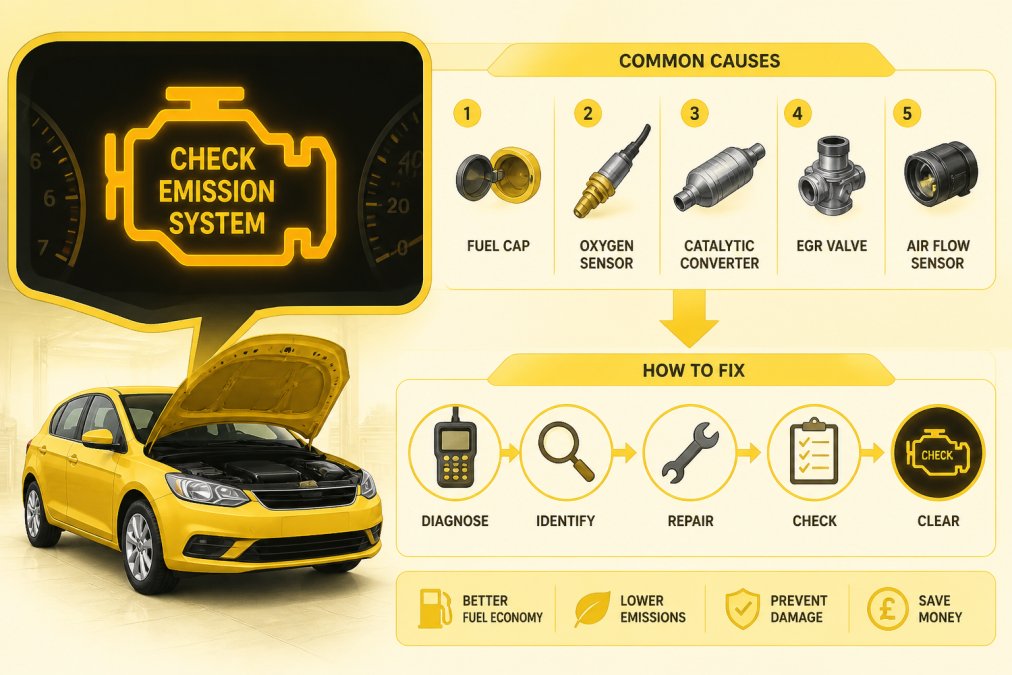
Your check emission system light tells you something is wrong with your vehicle's emissions control system. This light appears on your dashboard when the car's onboard diagnostic system detects a fault. It doesn't mean your engine will stop, but it does mean you need attention soon.
The emissions system controls harmful gases your engine produces. When it fails, your car releases more pollution and may fail its MOT test. The light can mean anything from a loose fuel cap to a serious catalytic converter problem.
Is It Safe to Drive With the Light On?
You can usually drive safely with the check emission system light on, but you shouldn't ignore it for long. The light itself isn't an emergency, your brakes and steering work normally.
However, your engine may run less efficiently. You might notice:
- Slightly worse fuel economy
- Reduced engine power
- Rough idling
- Difficulty starting
Book a diagnostic test within a week. Driving for months with the light on can cause more damage and higher repair costs.
Common Causes of the Check Emission System Light
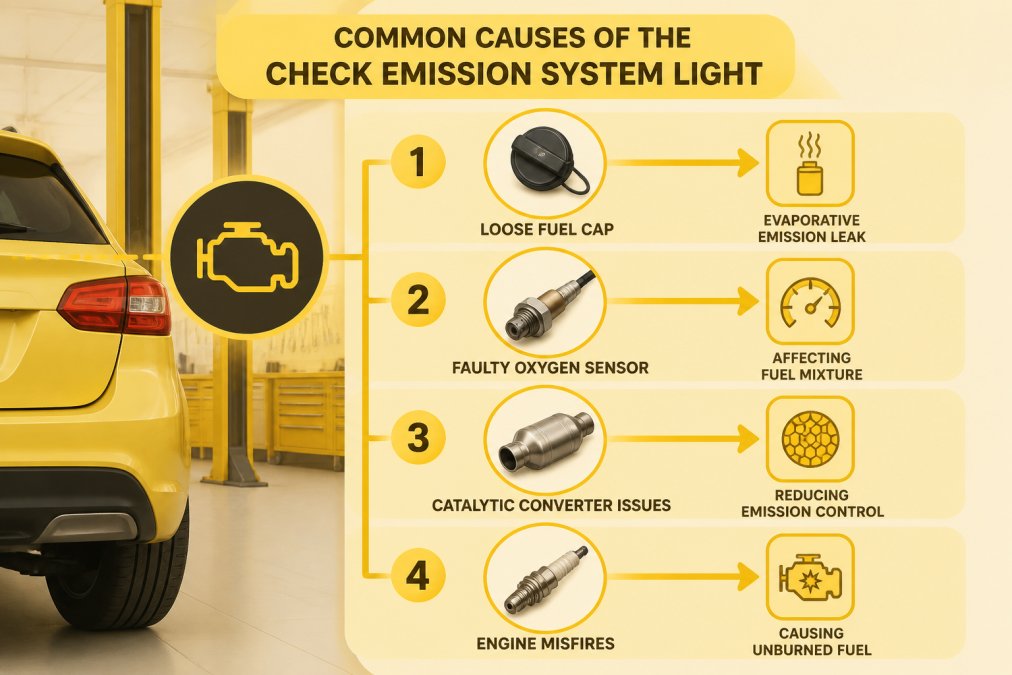
The check emission system light has four main causes. Understanding which one affects your car helps you plan repairs and know what to expect.
Loose or Missing Fuel Cap
A loose fuel cap is the simplest cause and the easiest to fix. Your fuel cap seals the petrol tank and prevents fuel vapours escaping. When it's loose or missing, the car's sensors detect an evaporative emission leak.
Check your fuel cap first. Tighten it firmly until you hear a click. If it's cracked or damaged, replace it. This solves the problem in most cases.
Your car's diagnostic system may clear the light automatically after a few drive cycles once the cap is fixed.
Faulty Oxygen Sensor
Your oxygen sensor measures how much unburned fuel leaves your engine. A faulty sensor sends wrong readings to the engine computer, which then adjusts fuel mixture incorrectly.
A bad oxygen sensor causes:
- Poor fuel economy
- Rough running
- Failed emissions test
- Check emission system light
Oxygen sensors wear out over time. If your car has high mileage, this is a likely cause. A garage can test the sensor and replace it if needed.
Catalytic Converter Issues
Your catalytic converter reduces harmful emissions by converting toxic gases into safer ones. When it fails, emissions rise and the light comes on.
Catalytic converter problems develop when:
- Engine misfires send unburned fuel into the converter
- Low-quality fuel damages the internal catalyst
- The converter gets clogged with carbon
- Age and mileage wear it out
A failing catalytic converter is expensive to replace. Get a professional diagnosis before assuming this is the problem.
Engine Misfires
An engine misfire means one or more cylinders aren't burning fuel properly. Unburned fuel enters the exhaust system, triggering the check emission system light.
Common misfire causes include:
- Worn spark plugs
- Faulty ignition coils
- Fuel injector problems
- Low fuel pressure
- Compression issues
Misfires also cause rough running and loss of power. A diagnostic test identifies which cylinder is misfiring and why.
Step 1: Check Your Fuel Cap
Start here before spending money on repairs.
What to do:
- Pull over safely and turn off the engine
- Open your fuel door
- Unscrew the fuel cap by turning it anticlockwise
- Look for cracks, damage, or worn seals
- Screw it back on firmly until it clicks
- Drive normally for 100 miles
The light often clears itself after a few days of normal driving if the cap was the problem. If it stays on, move to the next step.
Step 2: Note Any Symptoms or Changes
Before getting a diagnostic test, write down what you notice about your car's behaviour. This helps the mechanic understand the problem faster.
Check for these symptoms:
- Rough idling or stuttering when stopped
- Loss of power when accelerating
- Difficulty starting the engine
- Unusual exhaust smell
- Higher fuel consumption than normal
- Vibration or shaking while driving
Also note when the light appeared. Did it come on suddenly or gradually? Was there any change to your driving or fuel quality?
Tell your mechanic about all of this. It narrows down the possible causes and saves diagnostic time.
Step 3: Get a Car Diagnostic Test
A professional diagnostic test reads your car's error codes and pinpoints the problem. This is the only reliable way to know what's wrong.
At Dalin Car Care in Dagenham, we use industry-standard diagnostic equipment to scan your vehicle's emissions system. The test tells us exactly which component is faulty.
What happens during a diagnostic:
- Mechanic connects a scanner to your car's diagnostic port
- Scanner reads error codes from the engine computer
- Codes tell us which system is failing
- Mechanic performs additional checks if needed
- You get a full report with recommended repairs
Don't guess or let someone tell you to replace expensive parts without a proper diagnosis. A diagnostic test costs far less than replacing the wrong component.
Will the Light Cause an MOT Failure?
Yes. Your vehicle will fail its MOT test if the check emission system light is on.
The MOT includes an emissions test. The examiner connects a scanner to check for active fault codes. If any emissions-related code is present, your car fails immediately.
You can't pass an MOT with this light on, even if your car drives perfectly. The test is strict because emissions standards protect air quality.
MOT Failure Repairs and Emission Faults
If your car failed its MOT because of an emissions fault, you need repairs before retesting.
The MOT retest process:
- Get a diagnostic test to identify the fault
- Have the fault repaired by a qualified mechanic
- Clear the fault codes using diagnostic equipment
- Book an MOT retest within 10 working days
- Pay a retest fee
Dalin Car Care provides MOT failure repairs and can handle the full process. We diagnose the problem, repair it, and clear the codes so you're ready for retesting.
Common emission repairs include replacing oxygen sensors, fixing spark plugs, repairing fuel leaks, or replacing catalytic converters. The cost depends on what's actually broken.
Common Mistakes to Avoid
Don't ignore the light. It won't go away on its own unless the problem is fixed. Driving with it on causes more damage.
Don't assume it's expensive. A loose fuel cap costs nothing. Only a diagnostic test reveals the real cost.
Don't replace expensive parts without diagnosis. Some people guess it's the catalytic converter and spend £500+ on replacement. A proper diagnostic saves you from this mistake.
Don't use cheap fuel. Low-quality fuel damages your catalytic converter and oxygen sensors. Use fuel from reputable stations.
Don't skip regular servicing. Worn spark plugs and dirty fuel injectors cause misfires. Regular maintenance prevents many emissions problems.
Don't clear codes yourself. Clearing fault codes without fixing the problem means the light returns within days. You're just hiding the problem.
Frequently Asked Questions
Is it safe to drive with the check emission system light on?
Short trips are usually safe, but prolonged driving can damage your catalytic converter and increase emissions. If the light flashes rather than stays steady, stop driving immediately and get professional help. A steady light means you should arrange a car diagnostic test soon, but you can usually drive to a garage. Avoid motorway speeds and heavy acceleration.
What are the most common causes of an emission system warning?
The most common triggers are a loose fuel cap, faulty oxygen sensor, catalytic converter problems, and engine misfires. A loose cap is the easiest to fix yourself. Other causes require professional diagnosis. Dalin Car Care provides comprehensive car diagnostic testing to identify the exact fault affecting your emission system.
Will an emission system light cause an MOT failure?
Yes. If your check emission system light is on, your vehicle will fail the MOT emissions test. The MOT failure repairs process requires fixing the underlying fault before retesting. Dalin Car Care offers MOT failure repairs and can diagnose and fix emission faults to get your vehicle through its next test.
Can a loose fuel cap really trigger the emission system light?
Yes, absolutely. A loose or missing fuel cap allows fuel vapours to escape, which the emission control system detects. This is the easiest fix: simply tighten the cap firmly and drive for a few journeys. The light should clear automatically after 10-20 miles of normal driving. If it doesn't, the fault is elsewhere and needs professional diagnosis.
If your check emission system light is on, book a diagnostic test with Dalin Car Care in Dagenham. We serve customers across the area including Barking, Becontree, Chadwell Heath, Romford, Rainham and Hornchurch. Our team identifies the fault quickly and explains your repair options with honesty and no pressure. Get your car back to passing MOT standards with transparent, professional service.